
We hear sounds all the time, like the alarm that wakes us up, or car horns when driving to work, and maybe even trains. I hear trains every day as I live next to a train track. I think you will agree that some sounds are pleasant and some are just plain annoying, like loud vehicles.
My wife and I just returned from Europe where we spent time with our daughter and her boyfriend. We’ve been to Europe several times now, and when it comes to sounds, Europe, like North America, has both pleasant and annoying sounds. I’d like to talk about one of the pleasant sounds that is commonly heard in European cities. I am talking about the sound of church bells.
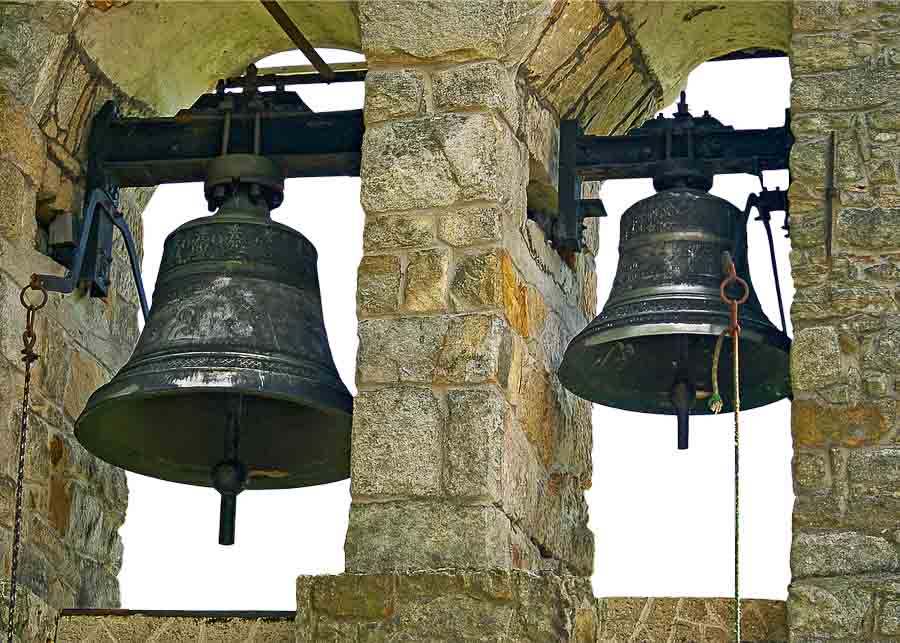
The last three times my wife and I were in Europe, I am amazed at how Church bells ringing affect her. Each time a church bell rings—some places ring them every hour—my wife stops to take them in. I once made the mistake of talking to her while bells were ringing at Mont-Saint-Michel in France. I was instantly told to stop talking. Sometimes she seems to be in a trance state. Now, I like the bells, but they’ve never put me in a trance.
According to the article, What Is the Origin and Purpose of Church Bells? some Christian churches have been ringing bells for spiritual and practical purposes such as to call the faithful to worship since the fifth century. The use of bells in churches dates back to 400 AD when an Italian bishop introduced bells as part of Catholic church services. During the middle ages, many believed that church bells held supernatural powers. It is said that the Bishop of Aurelia rang the bells to warn locals of an impending attack and when an enemy heard the bells, they ran in fear. The belief in the power of the bell continued into the 18th century when bells were rung to drive away evil, to heal the sick, to calm storms before a journey, to protect the souls of the dead and to mark days of execution. Did you catch that? Bells were rung to heal the sick. Perhaps that is why my wife is so drawn to them; to take in their healing energy.
According to Psychology Today’s, The Healing Power of Sound as Meditation, sound healing has ancient roots in cultures all over the world, including Australian aboriginal tribes who used the didgeridoo as a sound healing instrument for over 40,000 years to ancient times like the Tibetan or Himalayan singing bowl spiritual ceremonies. According to the article, Sound Healing: Definition, History, Types and Benefits, the Ancient Egyptians believed musical incantations could be an effective way to treat illness as did some Native American tribes who believed that certain sounds had healing powers. In the ancient Indian practice of nada yoga, yogis use sound vibrations to calm the mind and release stress. Greek philosopher Pythagoras discovered musical intervals and was the first to prescribe music as medicine. According to an article titled, The History of Sound Healing, in written history we find references to healing temples built with the intention to harness the three most powerful universal forces: sound, light and magnetics. These temples were constructed on magnetic vortices with architecture designed to capture the power of sound and light waves. People traveled to these locations to spend one or more nights for a resonant recalibration of body, mind and spirit. Sound healing has been around for thousands of years.
Today, sound meditation is becoming more popular because it is a form of focused awareness meditation. One type of sound meditation is called “sound baths,” which uses Tibetan singing bowls, quartz bowls, and bells to guide the listener. The above mentioned article, The Healing Power of Sound as Meditation, refers to a study published in the Journal of Evidence-Based Integrative Medicine which found that an hourlong sound meditation helped people reduce tension, anger, fatigue, anxiety, and depression while increasing a sense of spiritual well-being. The sound meditation used a range of Tibetan singing bowls, crystal singing bowls, gongs, and various other sound instruments, but the main instrument used was the singing bowls for the majority of the session. The people who had never done sound meditation experienced significantly less tension and anxiety afterward, as well as those who had done it before.
My wife does sound baths or sound meditation, so I am fortunate to experience them often. I can personally attest to their affects. I typically become very relaxed, often going in and out of sleep, and I always leave a sound bath feeling less tense, less stressed and have a sense of peace.
In the article, WTF Is Sound Healing, Really? integrative and functional medicine practitioner,
Mark Menolascino, M.D. is quoted saying
“If listening to Tibetan singing bowls or using a tuning fork makes people feel better, whether they have a broken leg, multiple sclerosis, or cancer, anything that puts that person in a more calm state will promote better healing. As a doctor, I just want to know: What’s the data that this benefits you? If there’s not enough data, is there any risk or harm to you? If not, I support it…”
According to the article, Scientific research on why to consider sound for healing. “a 2006 study found that sound resonance therapy (SRT) is a highly effective treatment for fibromyalgia, a condition which is generally very difficult to manage. SRT is administered using a vibro-acoustic apparatus which “stimulates the auditory and the somatosensory system of an individual, triggering long-term memory” – the therapy reportedly allows emotions to surface so they may be processed cognitively. This has encouraging implications for a vast number of medical conditions which may have underlying emotional or psychological causes.”
Dr. Andrew Weil, author, lecturer and founder of the Program in Integrative Medicine in Tucson, Arizona, states that “The new science of psychacoustics — the study of the effect of music and sound on the human nervous system — shows that [frequency] can relieve pain, help stroke patients, and benefit other conditions.” (Source: Sound Love Alchemy)
According to author and lecturer Dr. Deepak Chopra, Ayurveda (an ancient Indian medical system) teaches that “The body is held together by sound, and the presence of disease indicates that some sounds are out of tune… primordial sound is the mysterious link that holds the universe together in a web that is the quantum field.” (Source: Sound Love Alchemy)
According to an Austin Texas Medical Researcher, “Music stimulation increases endorphin release and this decreases the need for medication. It also provides a distraction from pain and relieves anxiety” –from research conducted at an Austin, Texas medical center. (Source: Sound Love Alchemy)
Science is now beginning to show what the ancients have always known, that is, that sound has benefits to the human body and has healing abilities. There are many studies supporting the benefits of sound therapy, too many for this blog post. I’ll provide more in future posts. I’m convinced sound heals, but do your own research. Even more, experience some sound baths to see how your body responds. You just might be amazed.
Some might say it’s the placebo effect. According to the Harvard Medical School article, the power of the placebo effect:
“Your mind can be a powerful healing tool when given the chance. The idea that your brain can convince your body a fake treatment is the real thing — the so-called placebo effect — and thus stimulate healing has been around for millennia. Now science has found that under the right circumstances, a placebo can be just as effective as traditional treatments.”
It doesn’t matter if it is the placebo effect. If you believe something, like a sound bath, will help you heal faster, it just might. Try it! You might be surprised.
 The Healing Realm
Leave a comment